[My Role]
UX Designer
[Team]
Manager and two UX Designer
[Stakeholders]
VP, Sales, BD, Design
[Status]
Dev in progress
Duration : Oct 2025 – Present
[02 — Problem Space]
01
02
03
04
05
“We spend more time finding where things are than actually writing the proposal.”
Business Development team — user interview


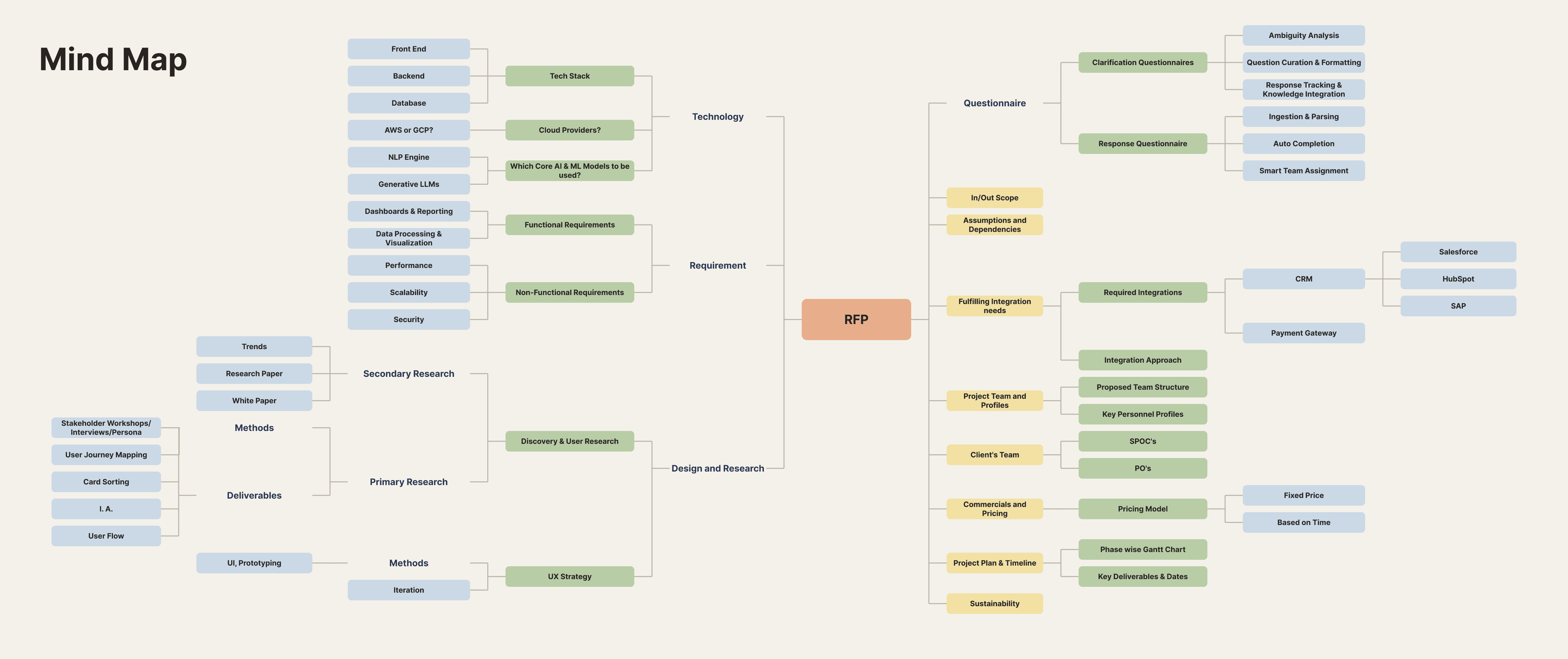
↗ View research artefacts in Figma
Nexus is designed around a simple idea: every document, decision, approval, clarification, and deadline for every RFP lives in one place — visible to the right people, at the right time, in the right format for their role.
AI co-pilot — Nexus


↗ Open in Figma

MC
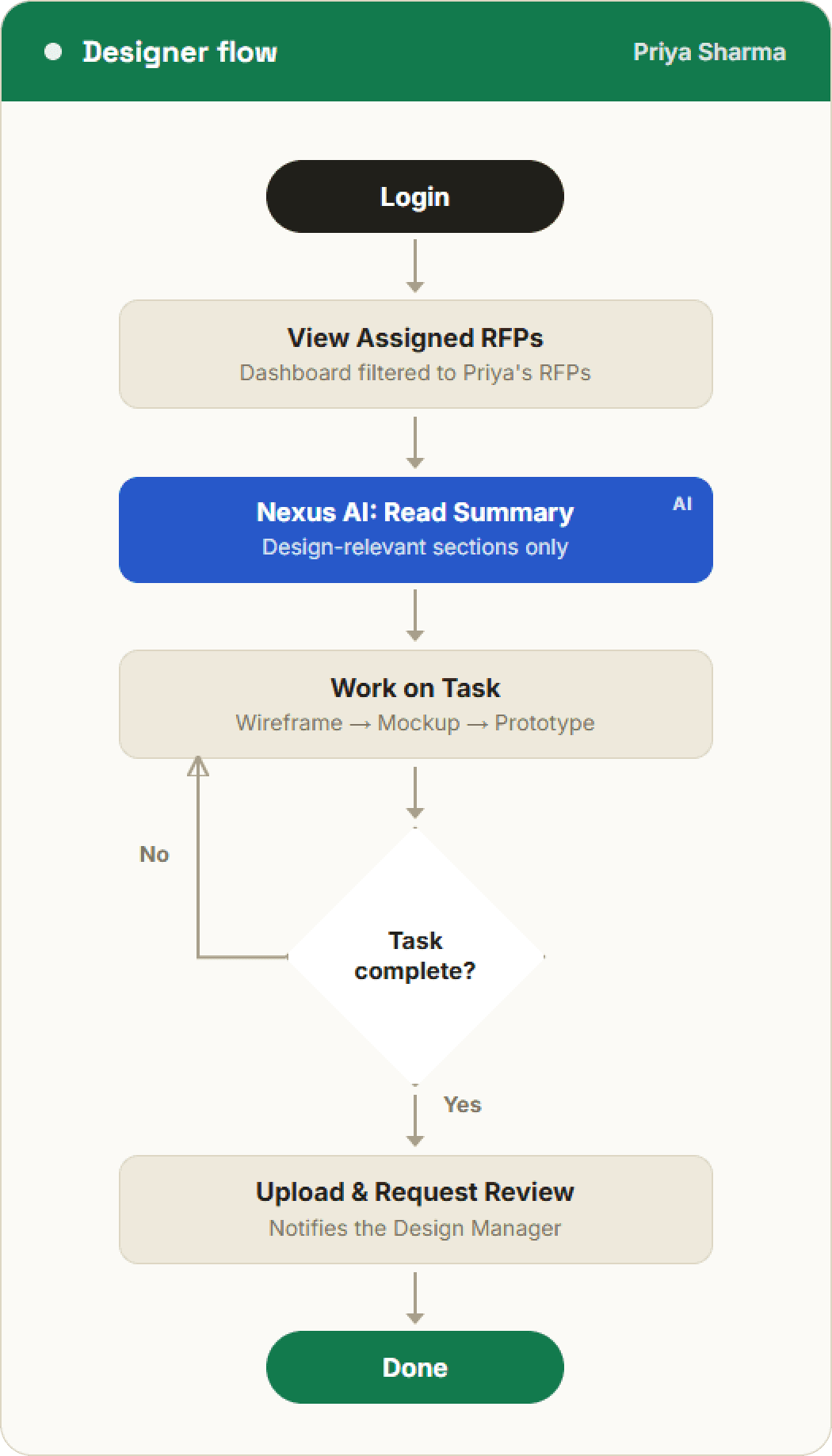
Priya Sharma — Designer
Executes RFP deliverables
Task list filtered to her assignments
AI summary of the design & UX section only
Countdown timer per RFP
One-click file upload and version tracking
JL
Arjun Mehta — Design Manager
Reviews and approves design output
Queue of deliverables awaiting review
Side-by-side compare of versions
Approve or reject with tracked comments
Escalation view for at-risk items
PS
Vikram Nair — Sales Head
Owns the commercial strategy per RFP
Pipeline view with deadline and deal size
Nexus -generated client intelligence brief
Risk flags and blocked items surfaced automatically
Submission readiness score per RFP
AK
Samira Khan — Unit Head
Strategic oversight of all proposals
"I only find out something went wrong after the
deadline has passed. I need early warning, not
post-mortem."
Portfolio view: all RFPs, all teams
Deal size, sector, and win/loss trend data
Team performance and capacity overview
Executive summary generated by Nexus AI
Each persona has a distinct journey through the platform — the same RFP, four completely different experiences.


[07 — Nexus AI]
[What makes Nexus different]
“AI that knows your role, your RFP, and your history — before you open the first document.”
Role-aware summaries
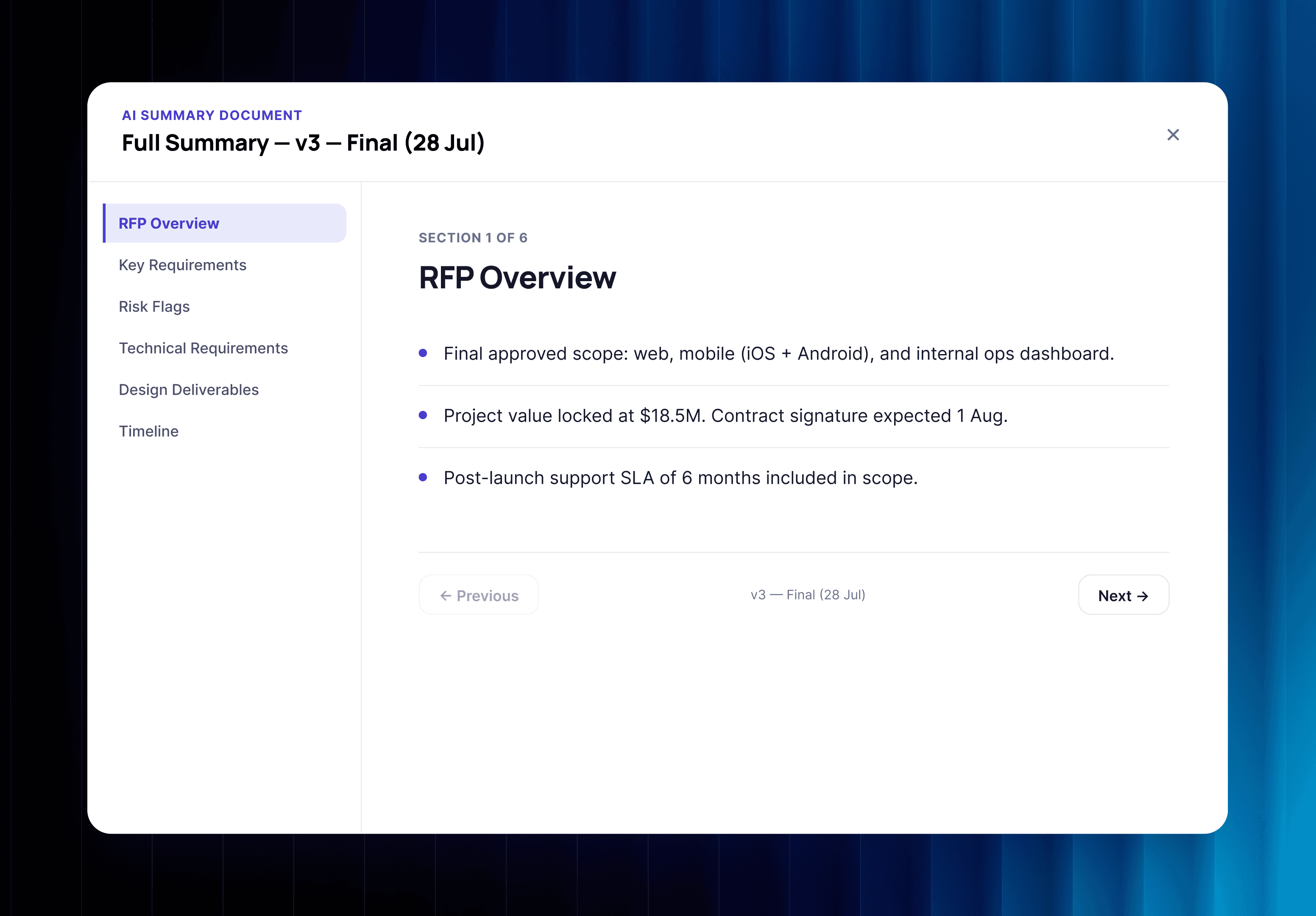
When a new RFP lands, Nexus reads the brief and generates a summary tailored to each role. A designer sees the design and UX requirements. A sales head sees the commercial context and client history. A unit head sees the strategic fit and risk profile. Same document — four different lenses.
Relevant past proposal retrieval
When a new RFP arrives, Nexus surfaces the three most similar past proposals — by sector, client type, deal size, or service line. Teams stop rebuilding content that already exists and start adapting what already worked.

Risk and deadline flagging
Nexus monitors every open RFP against its deadline and task completion status. When something is at risk — a blocked approval, a missing deliverable, a deadline three days away — it flags it proactively. No one has to notice. The system notices for them.

Internal system integration
Design is complete. The Design Team has delivered end-to-end designs for all four role-based experiences, the AI co-pilot interface, the full RFP lifecycle view, and the pipeline dashboard. The development requirement brief has been written and submitted.
Nexus AI co-pilot interface — role-aware summaries, past proposal retrieval, risk flags
