[My Role]
UX Designer
[Team]
CLO, Director, POs, Manager, UX Designer
[Platform]
Web · Mobile · Voice
[Project Overview]
The brief came directly from Cognizant’s CLO: redesign the L&D ecosystem for 200,000+ employees. Not an iteration on the existing LMS —a rethink of where, when, and how learning happens.
We introduced the product team to AI-powered, ambient learning concepts they’d never worked with. We designed under real time pressure, with a backend team dependent on our output. And we shipped.
[Problem Statement]
[The core tension]
“Employees are expected to grow continuously — but the systems that exist for learning interrupt the very work they’re supposed to support.”
The result: training gets postponed, certifications get rushed, knowledge stays theoretical, and the organisation can’t see whether any of it is working.


[Problem Space]
We worked from the CLO’s brief, organisational data, and desk research across learning behaviour, workplace psychology, and enterprise AI. Four failure modes consistently emerged — and they were feeding each other.
No time, no space
Back-to-back meetings make learning feel like a second job. “I’ll do it later” becomes never.
Low psychological safety
Fear of judgment stops people from asking basic questions. Gaps stay hidden and widen quietly.
One size for everyone
Same module for a new grad and a senior manager. Same format, same pace, same irrelevance.
Pushed, not pulled
Learning assigned top-down has no internal momentum. Without visible impact, it competes with real work — and loses.
“The real problem isn’t time. It’s that learning never feels like it belongs inside the workday.”
Internal synthesis — team brainstorm, from CLO brief and desk research
[Archetypes]

The Overloaded Deliverer
Mid-level, client-facing · 5–8 years exp.
“I want to grow but I genuinely can’t find a free hour. And then the course expires.”
Delivery pressure
Client-facing
Time-poor
High performer
[Goals]
Learn skills that immediately apply to current projects
Grow without sacrificing delivery quality
Feel recognised for development effort
[Frustrations]
Learning slots conflict with client commitments
Content is too generic to feel immediately useful
Progress resets when a module expires

The Silent Doubter
Junior · 1–3 years exp.
“Everyone else seems to know this already. I don’t want to be the one who asks.”
Fear of judgment
Junior
Eager to grow
Self-sufficient learner
[Goals]
Build confidence without exposing gaps publicly
Get answers without needing to ask people
Learn in a space that feels safe and private
[Frustrations]
Group sessions where basic questions feel embarrassing
No one-on-one way to check understanding
Imposter syndrome amplified by public assessments
[Process]
We didn’t run user interviews — the timeline didn’t allow it. What we had was a well-briefed CLO, a focused team, and the discipline to do intensive desk research before touching a single frame. A backend team was waiting on our specs, which made every decision consequential.
[Working Constraints]
Backend team dependent on our specs — design had to move fast
No time for primary research — CLO brief, data, and desk research only
Small team — structured brainstorming replaced traditional UX process
First version was always a directional concept, not a final spec
[01 Stakeholder briefing]
Understanding the mandate
Reviewed CLO brief and existing L&D metrics
Aligned on business goals and definition of success
Established what leadership needed vs. what employees needed
[02 Desk research]
Learning from what exists
Studied Zero UI, ambient AI, and voice interface precedents
Benchmarked enterprise L&D platforms and failure patterns
[03 Team synthesis]
Brainstorming the future
Facilitated structured internal workshops to map archetypes
Built a scenario matrix mapping archetypes × learning moments
Reviewed matrix with stakeholders — selected top 5 priority scenarios
[04 Education & alignment]
Bringing the team along
Ran internal sessions showing AI-in-learning examples to product team
Built shared vocabulary for ambient and Zero UI concepts
Got buy-in before any screen was designed

[The Zero UI Concept]
This wasn’t a brief we received. It was a concept we introduced — first to ourselves, then to a product team that had never thought about AI in learning this way before.
[The original vision — before any screens existed]
“A developer goes quiet for 20 minutes. The system detects the pattern and asks: ‘Looks like you might be stuck — want a hint?’ No app. No login. No interruption.”
Ambient, invisible, context-aware. The system comes to you. You never have to go looking for it. We called this Zero UI — not because there’s literally no interface, but because the effort of using it is zero.
🎯
Contextual detection
🔔
Ambient nudge
A notification arrives — not disruptive, just present. “You have a client call in 30 min. Want a quick briefing?”
💬
Conversational help
On-the-go coding help, concept explanations, or
interview prep — all through natural conversation.
[Educating Before Designing]
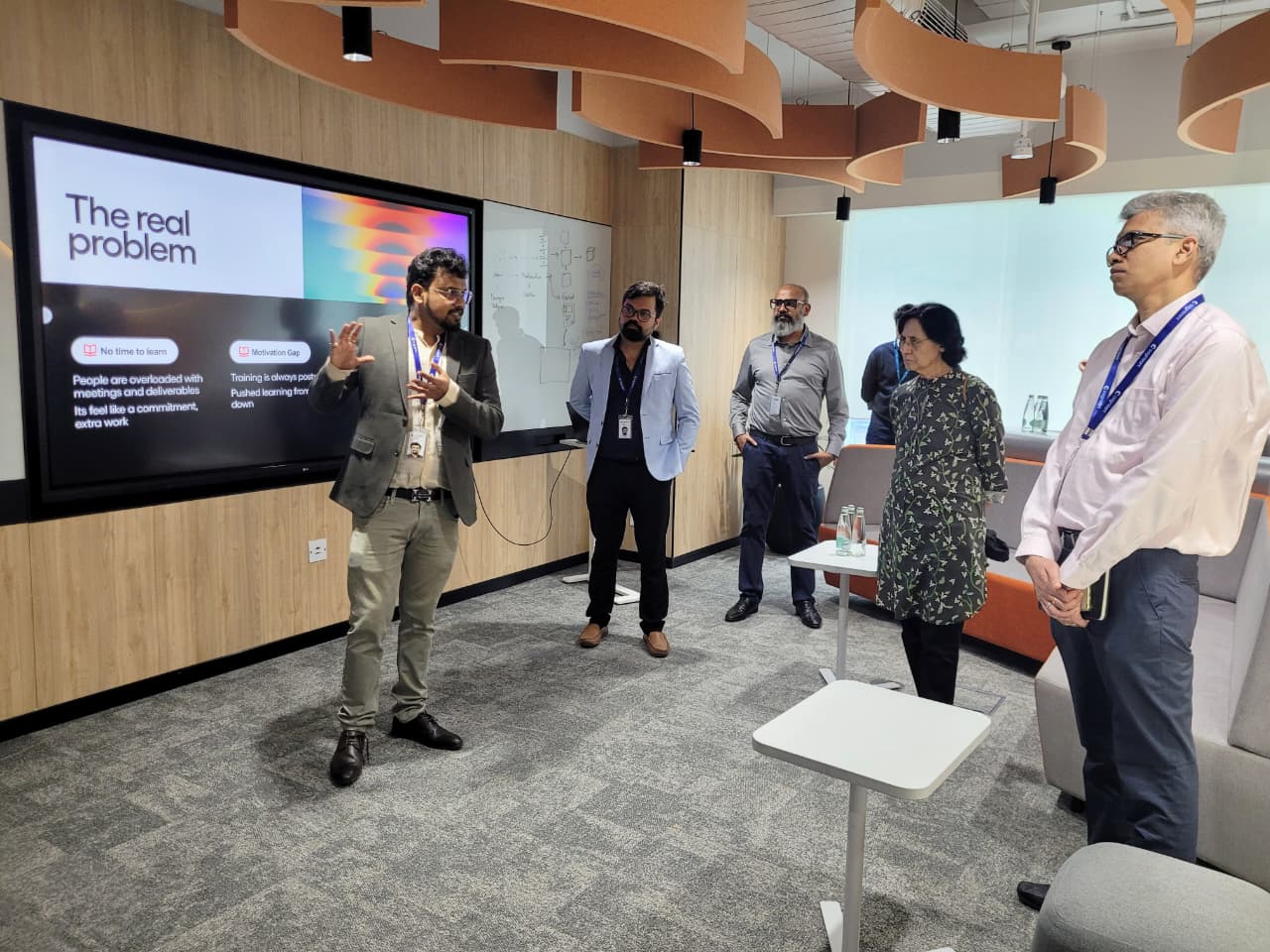
First, we had to bring the product team with us
The product team had never worked with AI in this way. Before a single screen was designed, we ran
internal sessions — showing examples of ambient AI in other industries, demonstrating what was
technically possible, and building a shared vocabulary for “learning in the flow of work.”
This wasn’t stakeholder management. It was design education. We were proposing a way of thinking the
team didn’t yet have a frame for.

[The Pragmatic Pivot]
The full vision hit real constraints — budget, technology, timeline
The ambient model required capabilities the dev team didn’t have: real-time behavioural inference, cross- tool context detection, deep integrations. The budget and timeline made it impossible in this cycle.
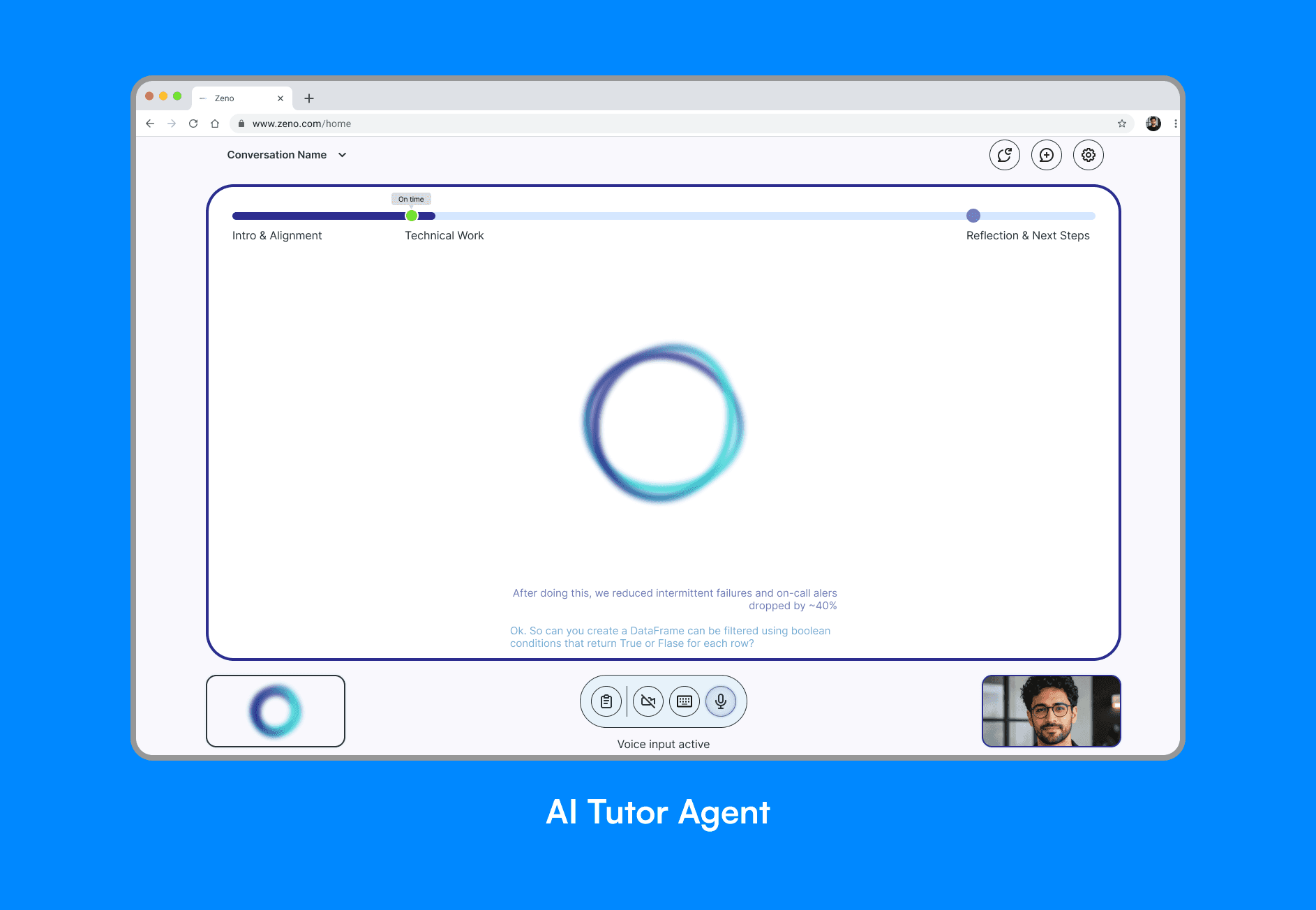
So we made a deliberate decision: instead of abandoning the concept, we asked “what’s the closest thing we can actually build?” The answer was a voice-based portal — a dedicated space where learners interact through natural conversation. Not invisible, but frictionless. Not ambient, but available.
[Our Framework]
Context
Triggered by real work
moments, not calendar
slots.
Continuity
Builds across sessions
without starting over.
Closure
Clear endpoints that
create real sense of
progress.
Critique
Safe feedback without
fear of peer judgment.
[Design Decisions]
Each transformation maps to the 4Cs. These aren’t feature additions — they’re architectural decisions
about where learning lives in an employee’s day.

One-size-fits-all learning paths
To
A hyper-personal tutor that adapts to you in
real time
Generic interview preparation
To
Role-specific simulations with actionable
feedback
Standard assessments
To
Personalised evaluations with clear
improvement paths
Unguided practice sessions
To
AI-assisted labs with real-time coding support
Idle waiting time
To
Micro-learning moments that maintain
momentum
Loss of motivation mid-course
To
Smart, timely nudges that re-engage at the right
moment

[Outcome]
The voice portal launched and is currently live for users.
5000
Beta
users
25
Scenario
Pathways
∞
Moments of
Learning
[Version 2 — My Proposal]
Six months after v1 launched, I came back to this project independently. Not because v1 was broken — but because I could see what it would look like if the constraints were lifted. This isn’t commissioned. It’s sitting with me, ready to propose when the moment is right.
What changed in v2
Side-by-side workspace for multitasking
Centralized access to all learning windows
More intuitive and contextual captions
Embedded mentor assistance during learning
What stayed the same
The 4Cs as the core design filter
Zero UI as the long-term north star
The belief that learning should live inside work,
not beside it


[Key Learnings]
Constraints are a design tool
Working under real time pressure and dependency produced sharper decisions. Not having time to second- guess forced clarity — and the voice portal pivot was better for it.
Design education is part of the job
Getting the product team to understand Zero UI before any screen existed was as important as the screens themselves. Without it, the concept wouldn’t have shipped at all.
Frameworks outlast the project
The 4Cs are still being used as a filter six months later — by a team making decisions I’m not in the room for. That’s the most durable output of the whole project.
